
A cornea transplant is one of the most successful and most commonly performed organ transplant procedures in the world — and in India, it is the treatment that restores vision to thousands of people each year who have lost sight to corneal disease, injury, infection, or dystrophy.
At Complete Eye Care, Gurgaon, corneal transplant surgery is performed personally by Dr. Parul Sony — MD trained at the Rajendra Prasad Centre for Ophthalmic Sciences, AIIMS New Delhi, and FRCS qualified from the Royal Colleges of Surgeons, UK. With 25+ years of corneal surgery experience, Dr. Sony performs the full spectrum of keratoplasty procedures: Penetrating Keratoplasty (PKP), Deep Anterior Lamellar Keratoplasty (DALK), Descemet Stripping Automated Endothelial Keratoplasty (DSAEK), and Descemet Membrane Endothelial Keratoplasty (DMEK).
What is a Cornea Transplant (Keratoplasty)?
A cornea transplant, also known as keratoplasty, is a surgical procedure in which a damaged or diseased cornea is replaced with a healthy donor cornea. The cornea is the clear, outermost layer of the eye that helps focus light onto the retina, allowing us to see clearly.
Damage to the cornea can occur due to various reasons, including:
● Eye injuries or trauma
● Corneal diseases like keratoconus or infections
● Scarring from long-term contact lens use
● Degenerative conditions
When the cornea is damaged, it can lead to blurred vision, eye pain, light sensitivity, or even partial loss of vision. In such cases, a cornea transplant is often the most effective solution to restore clear vision.
At Complete Eye Care, Gurgaon, under the guidance of Dr. Parul Sony, patients receive advanced care using the latest technology to ensure optimal outcomes for cornea transplant surgery.
When is Cornea Transplant Surgery Required? — Conditions We Treat in Gurgaon
A corneal transplant is recommended when the cornea is so severely damaged or diseased that vision cannot be adequately restored by glasses, contact lenses, or less invasive treatments. The following are the principal indications we treat at Complete Eye Care, Gurgaon:
Advanced Keratoconus
Keratoconus is the most common indication for corneal transplant in young adults in India. When the progressive thinning and bulging of the cornea has advanced beyond what C3R crosslinking, Intacs rings, or ICL can manage — particularly when significant corneal scarring has developed at the cone apex — corneal transplant becomes necessary. Deep Anterior Lamellar Keratoplasty (DALK) is the preferred technique for keratoconus, as it preserves the patient's own healthy endothelial layer and carries a lower rejection risk. See our dedicated Keratoconus page for full information on the staged management of keratoconus.
Corneal Scarring
Scarring of the cornea from any cause can permanently impair corneal transparency and visual acuity. Common causes of corneal scarring requiring transplant include: bacterial or fungal corneal ulcers that have healed with opacity, viral keratitis (particularly herpetic disease) causing recurrent or confluent scarring, chemical burns to the ocular surface, traumatic injuries with corneal laceration and scarring, and trachoma — a bacterial infection historically responsible for enormous corneal blindness burden in India.
Fuchs' Endothelial Dystrophy
Fuchs' dystrophy is a hereditary condition in which the endothelial cells of the cornea — the innermost layer responsible for keeping the cornea clear by continuously pumping water out — gradually fail and die over decades. As endothelial cell density falls below a critical threshold, the cornea swells (oedema), becomes hazy, and vision deteriorates. Patients often describe worse vision in the morning (when the closed eye accumulates more corneal swelling) that improves as the day progresses and the cornea partially dehydrates in open air. Fuchs' dystrophy is an excellent indication for endothelial keratoplasty (DSAEK or DMEK) — which replaces only the failing endothelial layer, preserving the healthy stroma and epithelium.
Bullous Keratopathy (Corneal Oedema After Eye Surgery)
Pseudophakic bullous keratopathy occurs when endothelial cells are damaged during intraocular surgery — most commonly cataract surgery — leading to progressive corneal oedema and vision loss. The cornea becomes waterlogged and painful. Endothelial keratoplasty (DSAEK or DMEK) is the treatment of choice, replacing only the diseased endothelium.
Corneal Infections — Fungal, Bacterial, and Viral Keratitis
Severe or recurrent corneal infections that leave behind significant scarring or opacity — particularly fungal keratitis (common in agricultural regions of India) and herpetic keratitis — may eventually require corneal grafting when the scar is visually significant and central.
Corneal Degenerations and Dystrophies
Various hereditary and acquired conditions cause progressive corneal degeneration: granular dystrophy, lattice dystrophy, macular dystrophy, and band keratopathy can all reach a stage where transplant is required.
Failed Previous Corneal Transplant (Re-Graft)
Corneal grafts occasionally fail due to rejection, primary graft failure, or late endothelial cell loss. A re-graft can restore vision in many cases. Re-grafts are technically more demanding than primary transplants and require specialist surgical experience.
Types of Cornea Transplant — PKP, DALK, DSAEK & DMEK
Modern corneal surgery has moved far beyond the single "full cornea replacement" approach of the past. Today, four distinct surgical techniques allow surgeons to replace only the specific layers of the cornea that are diseased — preserving healthy tissue, reducing rejection risk, and achieving faster visual recovery. At Complete Eye Care, Gurgaon, Dr. Parul Sony performs all four techniques and selects the most appropriate one based on which corneal layers are affected in each individual patient.
1. Penetrating Keratoplasty (PKP) — Full-Thickness Corneal Transplant
Penetrating Keratoplasty is the original and most established form of corneal transplantation, with over a century of clinical history. In PKP, a circular button of the full-thickness cornea — including all five layers: epithelium, Bowman's layer, stroma, Descemet's membrane, and endothelium — is removed using a circular blade (trephine) and replaced with a matching full-thickness disc of donor cornea. The donor button is secured with fine sutures (typically 16–24 interrupted or running sutures) that must remain in place for 12–18 months to support healing.
PKP remains the most appropriate technique when disease affects all layers of the cornea simultaneously — for example, in severe corneal scarring, advanced keratoconus with central scarring, or total corneal opacification. It carries a higher rejection risk and longer visual recovery (12–24 months for stable vision) compared to lamellar techniques, but remains the most complete and versatile corneal surgery available.
Best suited for: Full-thickness corneal opacification, scarring involving all layers, re-graft cases, and conditions not amenable to selective lamellar techniques.
2. Deep Anterior Lamellar Keratoplasty (DALK) — Partial Thickness for the Front of the Cornea
DALK has revolutionised the surgical treatment of keratoconus and anterior corneal scarring. In DALK, the surgeon removes the outer and middle layers of the cornea (the epithelium, Bowman's layer, and full thickness of the stroma) while carefully preserving the patient's own healthy innermost layers — Descemet's membrane and the endothelium. These preserved layers are then draped with donor stromal tissue to replace what was removed.
The critical advantage of DALK over PKP is the preservation of the host endothelium. Since the endothelium is the layer most responsible for corneal graft rejection, DALK carries a dramatically lower rejection risk than PKP. The graft cannot be rejected by the endothelial immune mechanism because the patient's own endothelium is intact. Sutures are still required, but visual recovery is generally faster and more predictable than PKP.
The technical challenge of DALK lies in achieving a complete deep dissection without inadvertently perforating Descemet's membrane — a complication that converts the procedure to a PKP. This requires significant surgical experience and skill.
Best suited for: Keratoconus, corneal stromal dystrophies, anterior and stromal corneal scarring where the endothelium is healthy (which is the case in most keratoconus patients under 50).
3. Descemet Stripping Automated Endothelial Keratoplasty (DSAEK) — Replacing the Inner Layer
DSAEK targets the opposite end of the cornea from DALK — the innermost layers. In DSAEK, the diseased Descemet's membrane and endothelium are stripped away from the back of the patient's cornea, and a prepared disc of donor posterior stroma, Descemet's membrane, and endothelium (approximately 100–150 microns thick) is inserted through a small incision and positioned against the patient's corneal back surface. An air bubble injected into the eye keeps the donor disc pressed against the patient's cornea while it heals and adheres.
Because no sutures are placed on the cornea surface, DSAEK produces far less post-operative astigmatism than PKP. The small incision heals quickly and reduces infection risk. Most patients achieve functional vision within 3–6 months — significantly faster than PKP's 12–24 month timeline.
DSAEK does not achieve quite the same visual quality as DMEK (the thicker donor tissue introduces some optical imperfection), but it is technically more forgiving and has been the workhorse of endothelial keratoplasty for over a decade.
Best suited for: Fuchs' endothelial dystrophy, bullous keratopathy (corneal oedema after cataract surgery), isolated endothelial disease where the stroma and epithelium are healthy.
4. Descemet Membrane Endothelial Keratoplasty (DMEK) — The Most Advanced Endothelial Transplant
DMEK represents the current gold standard for endothelial keratoplasty. In DMEK, only the Descemet's membrane and the endothelial cell layer are transplanted — a tissue disc just 10–15 microns thick (compared to 100–150 microns for DSAEK). This ultra-thin tissue provides the closest possible approximation to the patient's original corneal anatomy at the back surface.
The extraordinary thinness of the DMEK graft produces superior visual outcomes compared to DSAEK — many DMEK patients achieve 20/20 or 20/25 vision within a few months. Rejection rates are even lower than DSAEK because so little foreign tissue is transplanted.
The technical complexity of DMEK is considerably higher than DSAEK — the Descemet's membrane roll must be handled with extreme delicacy, oriented correctly inside the eye, and unrolled perfectly. This demands a higher level of surgical expertise and experience. The rebubbling rate (need to re-inject the air bubble) is higher with DMEK than DSAEK, but does not typically affect the final visual outcome.
Best suited for: Fuchs' endothelial dystrophy, isolated Descemet's/endothelial disease, patients who want the best possible visual outcome with the lowest rejection risk.
Benefits of Cornea Transplant
A cornea transplant is a life-changing procedure that not only restores vision but also improves the overall quality of life. Some of the key benefits include:
1. Restored Vision
One of the most significant advantages of cornea transplantation is restored eyesight. Patients who have struggled with blurred or distorted vision for years can regain the ability to see clearly, recognize faces, and appreciate colors and fine details.
2. Enhanced Quality of Life
Restored vision allows patients to participate in daily activities, work, and hobbies that were previously difficult or impossible. Many patients report feeling more confident, independent, and emotionally uplifted after the surgery.
3. Reduced Pain and Discomfort
Chronic pain or discomfort caused by corneal damage, irritation, or infections can be significantly reduced after a successful transplant. Patients often no longer need harsh medications that may have side effects, leading to a more comfortable and normal lifestyle.
4. High Success Rate
Cornea transplants are highly successful. In fact, more than 98% of transplants result in significant vision improvement. The success depends on careful preoperative evaluation, surgical precision, and proper post-operative care.
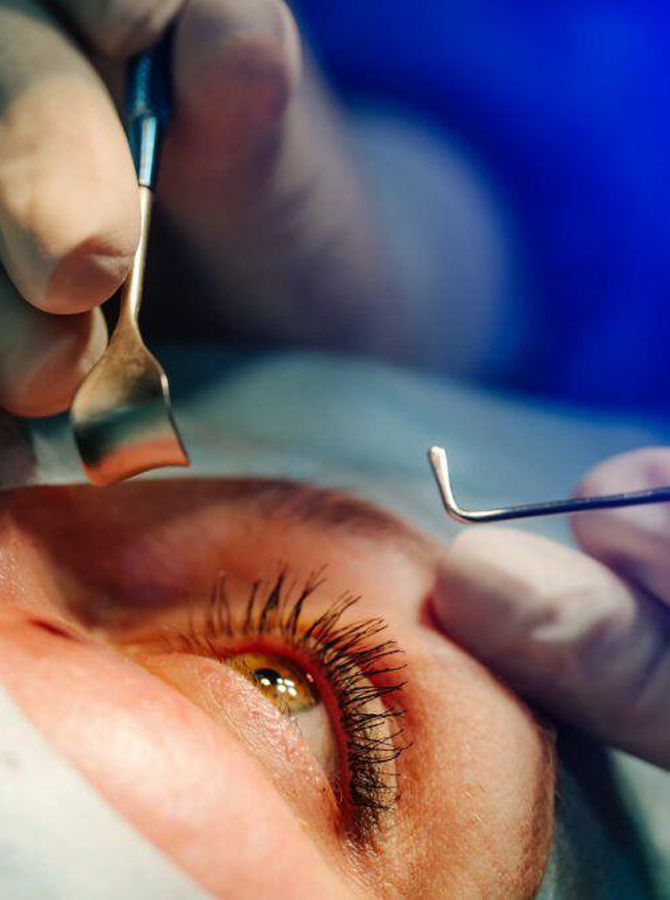
Preparing for Cornea Transplant Surgery
At Complete Eye Care, Gurgaon, preparing for a cornea transplant is a carefully planned process. Dr. Parul Sony and her team ensure that patients fully understand the procedure, recovery process, and expected outcomes.
Steps Before Surgery:
1. Comprehensive Eye Examination: Detailed tests assess the overall health of the eyes and identify any potential complications.
2. Donor Cornea Selection: The suitability of the donor cornea is carefully checked to match the patient’s needs.
3. Preoperative Instructions: Patients receive clear guidelines about fasting, medications, and what to expect on the day of surgery.
4. Scheduling Surgery: Once all tests are complete, a surgery date is set according to the patient’s convenience.
On the Day of Surgery:
● Patients arrive at the hospital and are guided to the preoperative area.
● Final instructions and checks are done by the surgical team.
● The surgery typically lasts about one hour.
● After the procedure, patients are moved to the recovery room for observation before being discharged.
Recovery and Postoperative Care
Recovery after a cornea transplant is crucial for the best results. Patients are advised to:
● Use prescribed eye drops regularly to prevent infection and reduce inflammation
● Avoid rubbing or pressing the eyes
● Attend all follow-up appointments with Dr. Parul Sony
● Wear protective eye shields while sleeping initially
Full visual recovery may take several weeks to months, depending on the individual case and healing process. With proper care, most patients experience significant improvement in vision and comfort.
Why Choose Complete Eye Care for Corneal Transplant Surgery in Gurgaon?
● Expert Surgeon: Dr. Parul Sony is an experienced cornea specialist with years of expertise in keratoplasty.
● Advanced Technology: The hospital uses modern surgical equipment for precision and safety.
● Comprehensive Care: From preoperative evaluation to post-surgery follow-up, patients receive personalized care.
● High Success Rates: Patients in Gurgaon trust Complete Eye Care for consistent and excellent surgical outcomes.